Flood light · Model B04
LX-TG-010 LED Flood Light
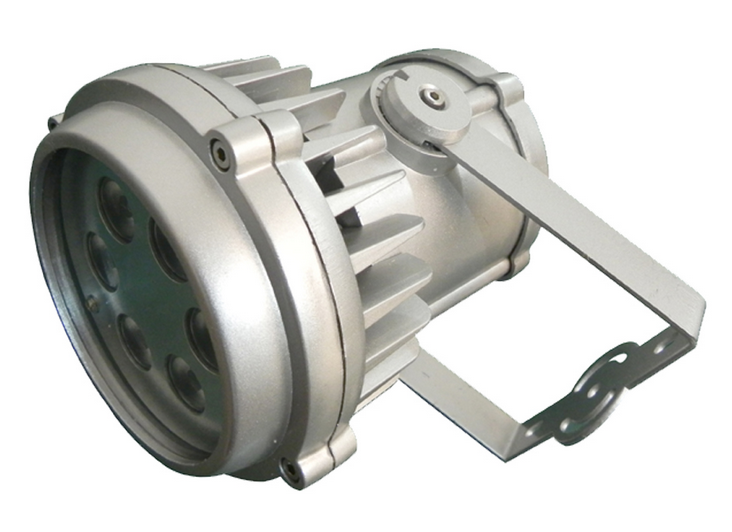
A compact round flood light on a U-shaped bracket. All its values are consolidated on this page.
Specifications
| Model | LX-TG-010 |
|---|---|
| Brand | LESAN |
| Power | 6W / 18W |
| Drive current | 300mA |
| Input voltage | DC24V / AC110V / AC220V |
| Power efficiency | >70% |
| Dimensions | ¢140mm × L150mm |
| Weight | 1.4 kg |
| Material | Aluminum, tempered glass |
| Housing colour | Silver-gray |
| Protection grade | IP65 |
| LED brand | CREE |
| Lens angle | 15° / 25° / 45° / 60° |
| Projection distance | 40M / 30M / 20M / 10M |
| Controller | DMX512 controller / on-off controller |
| Warranty | 1 year |
| Applications | Fountains, waterfalls and rockery or bridge lighting |
A small fitting with a long throw
At 140mm across and 1.4 kg, the LX-TG-010 is the lightest flood light in the range, yet its page lists projection distances up to 40M through the narrower lens angles — the combination that suits accent work: a rockery, a bridge parapet, a small facade sign, where the fitting should disappear and the beam should carry. Two power steps (6W and 18W) and three input options (DC24V, AC110V, AC220V) widen the electrical fit, and control is DMX512 or on-off. Its applications reach from fountains and waterfalls to rockery and bridge lighting; the fitting itself is rated IP65, so positions are splash-exposed and above the waterline, not submerged.
Confirm before ordering
Confirm the power step and input voltage for your configuration, and note this model's warranty term when you compare it with other models. When you write, ask what minimum order quantity and lead time apply to the variant you have chosen. Certificates available upon request.
Small fitting, serious optics
It is tempting to file a 140mm, 1.4 kg flood light under "garden light" and move on. The specification argues otherwise: four lens angles, a projection ladder reaching 40M, three input voltages and two control methods is the specification of an instrument, not a decoration. The correct mental model is a scaled-down professional flood: the same decisions, made the same way, at accent scale. Where a bar flood light covers a field, this fitting covers a subject — and subjects are most of what landscape and waterscape lighting actually is.
Choosing the power step and the input
The 6W step is the marker-light setting: a rockery group, a small water stair, a bridge parapet detail, where the fitting should be felt rather than seen working. The 18W step is the working setting for subjects at real distance, paired with the narrower lenses. Input choice follows the site's electrical story: DC24V where the project already runs a low-voltage landscape network (and where the underwater fittings' 24V logic makes the whole waterscape one system), AC110V or AC220V where the accent points sit on existing mains circuits and a separate low-voltage run would be the tail wagging the dog. All three are options of the same model; the choice is made per position, and a mixed site can legitimately run both.
Application reading, carefully
Its applications reach from fountains and waterfalls to rockery and bridge lighting, and the IP65 grade draws the line through that list: this is a fitting for the wet-adjacent positions — the rim of the fountain, the rocks beside the fall, the bridge structure above the water — not for the submerged ones. Read that way, it completes the waterscape kit rather than competing with it: the submersible models inside the water, this model on everything the water touches but does not cover. In dry service the same fitting is a general accent flood for facades, signs and planting, which is how a single stocked model ends up serving a whole site.
Bracket and aiming practice
The U-bracket format aims in one plane, which is a virtue: set the tilt, lock it, and the beam stays where the design put it. Aim at dusk, not at noon — the difference between the 25° and 45° lens on the same subject is a night-time judgement — and once aimed, note the tilt per position in the site record so a replaced fitting returns to the same beam instead of a fresh guess.